The landscape of higher education in Australia has undergone a seismic shift over the past decade. No longer is the university experience solely defined by lecture halls and library sessions; it is now a high-stakes environment where academic excellence is the primary currency. As Australian institutions continue to climb global rankings, the pressure on students to perform has intensified, leading to a significant surge in the need for professional academic intervention across all major faculties.
In major education hubs like Sydney, Melbourne, and Brisbane, students are navigating a curriculum that is increasingly complex and fast-paced. This evolution has prompted a shift in how students approach their coursework. Many are discovering that traditional classroom hours are often insufficient to master the depth of knowledge required for modern degrees. Consequently, the reliance on professional assignment help Australia has transitioned from being a supplementary luxury to a core component of a successful student’s academic toolkit, allowing them to bridge the gap between classroom theory and practical application.
This trend is particularly evident in professional degrees where the margin for error is non-existent. For instance, the legal sector in Australia demands an extraordinary level of precision and adherence to specific jurisdictional precedents. Students tackling the intricacies of the Australian legal system often find that specialized law assignment help is essential for interpreting complex case law and legislative frameworks. By engaging with mentors who possess field-specific expertise, students can ensure their submissions meet the rigorous standards expected by Australian law faculties without falling behind their peers.
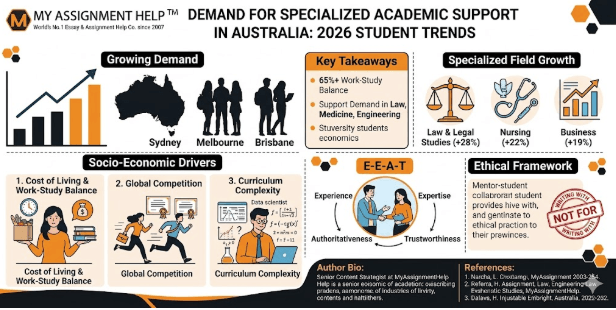
Key Takeaways
- Time Poverty: Over 65% of Australian students balance full-time study with significant part-time employment.
- Specialized Focus: Support demand is highest in Law, Medicine, and Engineering due to strict professional accreditation.
- Retention Benefits: Professional mentoring is proven to reduce academic burnout and stress-related withdrawals.
- Digital Evolution: The shift toward digital-first education has made online academic consultancy a primary resource for regional students.
See also: AR and VR in Business Innovation
The Socio-Economic Drivers of Academic Support
Understanding why students seek support requires a look at the socio-economic pressures unique to Australia. The cost of living in Australian metropolitan areas remains among the highest in the world. This fiscal reality forces a majority of the student population into the workforce while simultaneously pursuing full-time degrees. The “time poverty” resulting from this dual commitment is a leading driver of the academic support industry.
1. Increased Global Competition
Australian universities are major players in the international education market. With a diverse cohort of domestic and international students, the competition for graduate positions at top-tier firms is fierce. Students recognise that a standard “Pass” is no longer enough; they require High Distinctions to stand out in a crowded job market where employers look for consistent excellence.
2. The Complexity of Modern Curricula
As industries evolve, so do the degrees that feed them. Data science, forensic accounting, and international law now require students to be polymaths. When a student is expected to master both qualitative analysis and technical software within a single semester, the depth of insight required often necessitates external guidance.
| Discipline | Support Demand Growth (YoY) | Primary Reason Cited |
| Law & Legal Studies | +28% | Case law complexity & IRAC formatting |
| Nursing & Healthcare | +22% | Placement-study balance |
| Business & Finance | +19% | Advanced data modelling requirements |
Addressing the Ethical Framework
In the Australian context, academic integrity is paramount. Modern support services have moved away from “writing for” students and toward “writing with” students. This collaborative model focuses on providing high-quality samples, structural guidance, and comprehensive research. By using these resources as study guides, students actually improve their own understanding of the subject matter, leading to better performance in exams where external help is not available.
Frequently Asked Questions
Q: Is academic support common in Australia?
A: Yes, seeking tutoring, mentoring, and research assistance is a standard part of academic life. Professional services provide model papers and guidance to help students understand their coursework better and manage heavy workloads.
Q: How does specialized help differ from general tutoring?
A: Specialized help, like law-specific support, focuses on the technical nuances of a particular field, such as AGLC4 referencing or specific Australian legislative standards, which general tutors may not be familiar with.
Q: Can support services help with time management?
A: Absolutely. By providing research frameworks and structural outlines, these services help students organise their thoughts faster, allowing them to meet tight deadlines without compromising quality.
Author Bio:
This article was authored by a Senior Content Strategist at MyAssignmentHelp. With over a decade of experience in the Australian higher education sector, the author specialises in helping students navigate the complexities of university life through data-driven insights and professional academic resources.
References:
- Australian Department of Education, Skills and Employment – 2024 Higher Education Statistics.
- Journal of Higher Education Policy and Management – “The Student Work-Study Balance in Australian Metros.”
- National Union of Students (NUS) Australia – Student Welfare and Academic Pressure Report 2025.